
2015-2025: Liviu Matenco1 and Fadi Henri Nader1,2,3
Starting with 2026: Piotr Krzywiec and Xiumian Hu
1 Utrecht University, Faculty of Geosciences, The Netherlands
2 IFP Energies Nouvelles, Rueil-Malmaison, France,
3 Presently at: École nationale supérieure des mines de Paris, Paris, France
4 Polish Academy of Sciences, Institute of Geological Sciences, Warsaw, Poland
5 Nanjing University, School of Earth Sciences & Engineering, Nanjing, China
Previous coordinators: Sierd Cloetingh (Amsterdam - Utrecht), William Sassi (Rueil-Malmaison), Francois Roure (Rueil-Malmaison), Magdalena Scheck-Wenderoth (Potsdam)
Summary
The focus of the International Lithosphere Program Task Force VI Sedimentary Basins activities is to foster collaborations between academia, research institutes, and industry in all domains relevant for the understanding of sedimentary basins, from regional to nano-scale, from the deep Earth to near-surface processes. Sedimentary basins contain the critical subsurface sustainable geo-resources and storage needed for the development of human societies and also the place of major populations around the planet, where geo-hazards also prevail with sometimes devastating impacts. Therefore, understanding the processes influencing such systems is primordial for the future of human societies. The Task Force encourages the development and validation of novel concepts of sedimentary basin evolution and topography building by incorporating geological/geophysical datasets and methodologies applied to worldwide natural laboratories. The Task Force aims to understand and predict the processes that control the formation and evolution of the coupled orogens and sedimentary basins system through integration of field studies, analytical techniques, and numerical/analogue modelling. The task force welcomes integrative collaborative research achieved by a wide range of approaches. We promote research in the domain of sedimentary basins evolution and quantitative tectonics for the study of mountain building and the subsequent extensional collapse, and their quantitative implications for vertical motions on different temporal and spatial scales. The implications of tectonics on basin fluids (rock-fluid interactions and flow) are important to understand and predict sustainable geo-resources and storage. It is important to initiate innovative research lines in linking the evolution of sedimentary systems by integrating cross-disciplinary expertise with a focus on integrated sedimentary basins and orogenic evolution. The key is to strengthen the synergy between academic research and applied industry in large (inter)national interdisciplinary research networks able to tackle complex problems at integrated system level. We aim to create a stimulating and motivating scientific environment for PhDs and post-doctoral fellows in collaboration with industry and research institutes.
The synergy of the Task Force is dedicated to the organisation of a major Workshop every year aimed at focusing the research in the larger domain of sedimentary basins, their coupling with orogenic areas, and with the underlying lithosphere. Such workshops have been organized all over the world, such as for instance in the period 2025-2025 in Tokyo, Japan, Clermont-Ferrand, France, Limassol, Cyprus, Quebec City, Canada, Heviz, Hungary, Utrecht, The Netherlands, Rueil-Malmaison, France, Bucharest, Romania, Abu Dhabi, United Arab Emirates, Krakow, Poland, and Riyadh, Saudi Arabia, which attracted around 100-200 participants. Some workshops are organised in conjunction with major international events, such as the International Sedimentological Congress, or as joint ventures with other task forces or workgroups of the International Lithosphere programme, such as TOPO-EUROPE and ILP Task Forces Subducted Lithosphere and Magma and Lithosphere. The Task Force is also present or sponsoring many other sessions of major geoscience meetings, such as at the European Geosciences Union (EGU) annual meetings.
The scientific achievements of the ILP Task Force VI Sedimentary Basins are presented at numerous international conferences and are often summarized in review articles of international journals (e.g., Matenco et al., 2020; Nader et al., 2024). The Task Force aims to publish around one special issue grouping 20-40 papers in major international journals per year, generally dedicated to its yearly workshops. For example, in the period 2015-2025, seven special issues were published in journals such as Tectonophysics or Global and Planetary Change as stand-alone Task Force initiatives or in collaboration with other task forces or workgroups of the International Lithosphere programme (e.g., Sato et al., 2017; Cloetingh et al., 2018; Matenco et al., 2022; Nader et al., 2023; Krzywiec et al., 2026).
Tectonic, surface, and external forcing processes are responsible for the growth and decay of continental topography and sedimentary basins, i.e. the interplay between sediment supply and mass (re)distribution with the full range of deep Earth to surface processes (Figs. 1 and 2, Matenco and Haq, 2020; Matenco et al., 2022). These are important to assess the impact of tectonics and sediment distribution in highly populated areas, affected by flooding events, regional landslides, and active seismicity. The mechanisms that link exhumation, formation of topography, sedimentation, and the evolution of geo-fluids are poorly understood because of a lack of insight into the variability of the rates and scales of the underlying processes. It is important to explore the dynamics of these processes by quantifying the link between tectonics and sedimentation with a multi-scale approach that combines field and laboratory studies, and basin-wide observations with process-oriented modelling and its feedback to original observations (Fig. 3, Nader et al., 2024). This will provide new opportunities to analyse and quantify the interplay between deep Earth and surface processes in sedimentary basins, critical for understanding sustainable geo-resources and storage, and natural hazards.
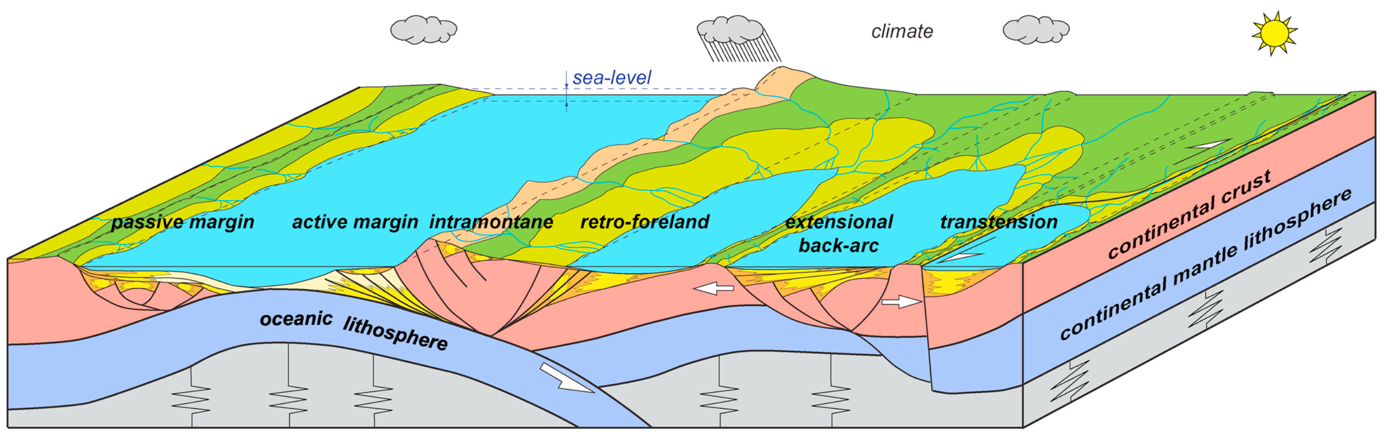
Fig. 1. Block diagram showing various plate tectonic regimes, the development of the associated depositional space and depositional facies in various types of sedimentary basins: from passive margins to active margins, to intramontane, continental retro-foreland, extensional back-arcs and continental strike-slip settings. Note that depositional space appears triangular in cross-sectional view against active faults, even when individual sub-basins are ultimately connected, and can be sourced from multiple directions at various elevations. When tectonics play a subsidiary role to other external forcing factors, such as eustatic fluctuations or climate, sediment source tends to be largely unidirectional, as for example along passive continental margins. After Matenco and Haq (2020).
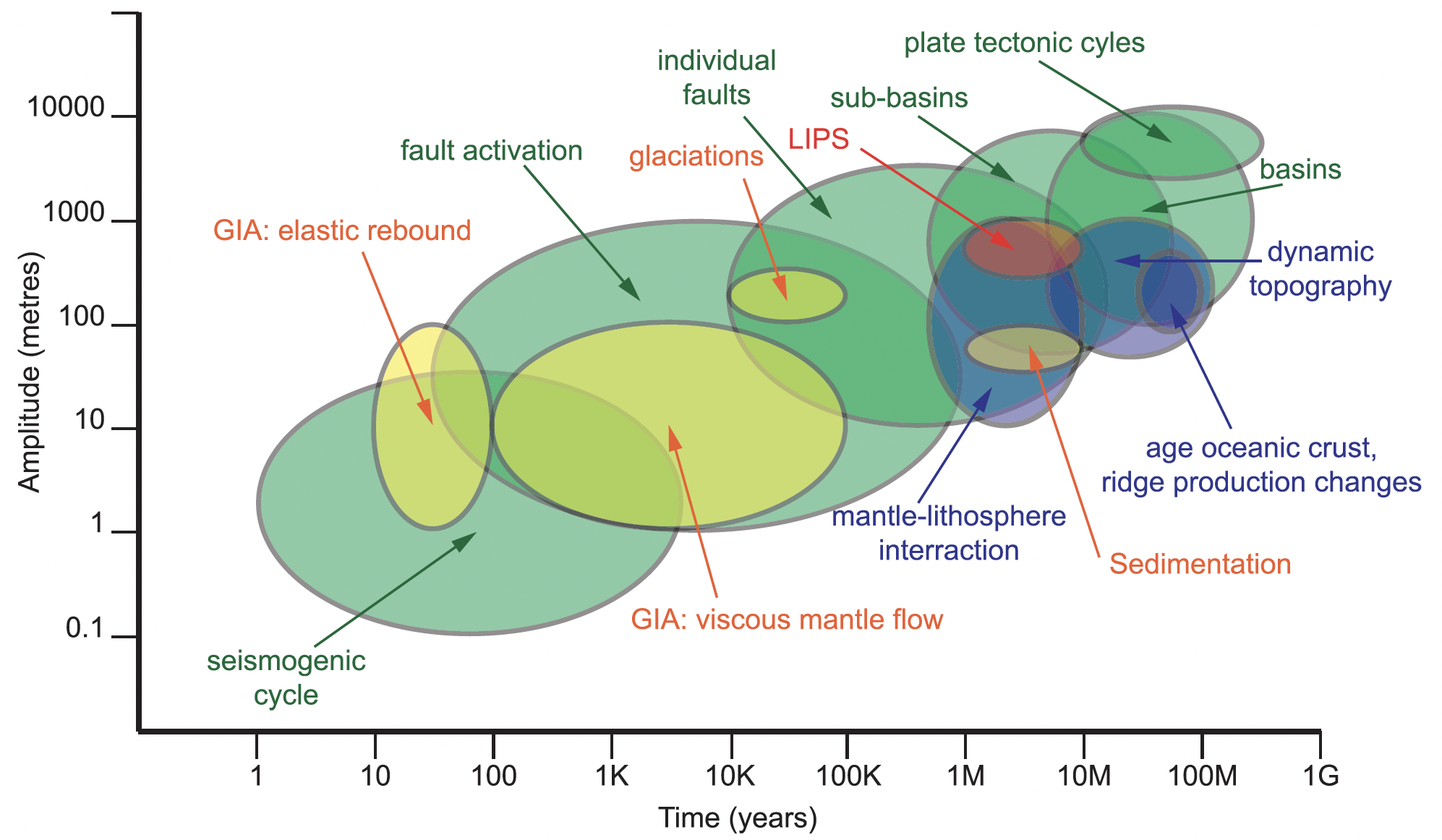
Fig. 2. Temporal and spatial variability of the mechanisms that drive observed sea-level variations and create or wipe out depositional space (note the logarithmic scale of both axes). Mechanisms that have a direct tectonic component are depicted in green, ranging from plate tectonic cycles to basins, sub-basins, individual faults, fault activation moments and seismogenic cycles. All other mechanisms have a primary impact in sea-level variations: larger scale mechanisms related to mantle-lithosphere interactions, dynamic topography and production of oceanic crust are shown in blue; changes due to magmatism in large igneous provinces (LIPS) are shown in red; mechanisms related to glaciations and sedimentation are shown in yellow. After Matenco et al., 2022.
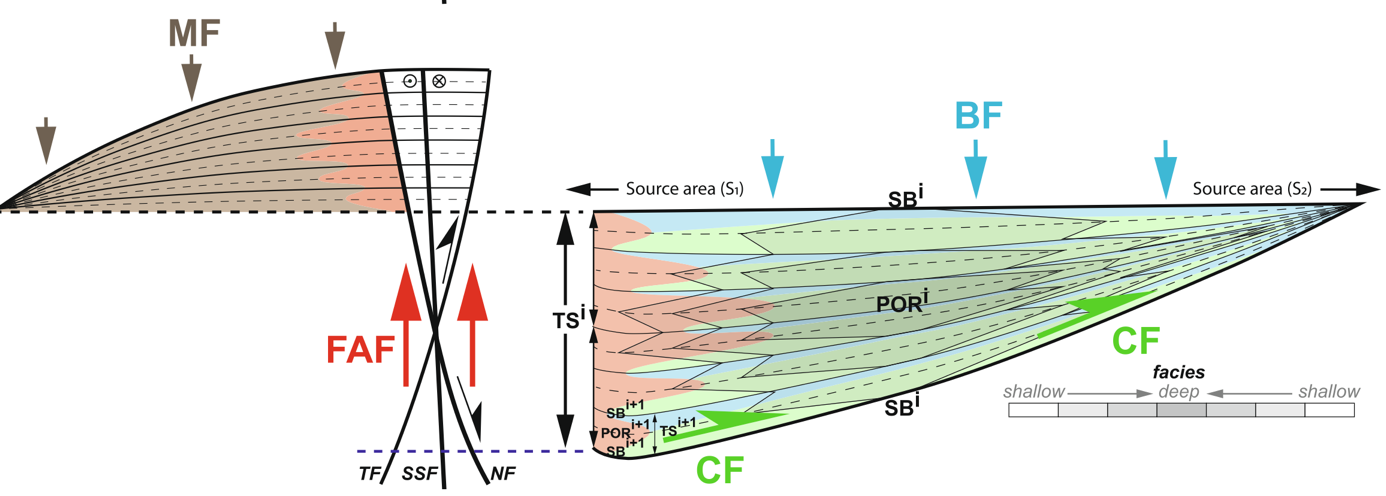
Fig. 3 - Conceptualization of time-independent diagenetic facies tracts within the framework of tectonic successions as defined by Matenco and Haq (2020). Tectonic successions (TS) have been defined as lower-order (i) and higher-order (i +1) packages of sediments in fault-bounded sedimentary basins that are composed of a sourceward-shifting facies tract (SFT) and a basinward-shifting facies tract (BFT). These facies tracts are separated at a point of reversal (POR), which is the position where the rate of sediment supply (δSS) exceeds the rate of creation of depositional space (δAS).The black lines in the middle indicate the type of faults, normal (NF), thrust (TF) and strike-slip (SSF), offsets that create the wedge-shaped depositional accommodation space in the hanging-wall, footwall or transtensive compartment of the fault, respectively. The opposite compartment records uplift that may exhume rocks to sub-aerial conditions (as sketched in the figure) or remain in sub-aqueous conditions (not sketched in the figure). S1 and S2 are the source areas of sediment supply, SL denotes sea-level, SB are succession boundaries, δSS is the rate of sediment supply, δAS is the rate of creation/destruction of the accommodation space. The direction of migration diagenetic fluids is illustrated with arrows (FAF: fault-associated fluids, CF: compaction fluids, BF: basin fluids, MF: Meteoric fluids). Similar colours illustrate diagenetic facies tracts (FADFT: fault associated diagenetic facies tract, BDFT: basin diagenetic facies tract, CDFT: compaction diagenetic facies tract, MDFT: meteoric diagenetic facies tract). After Nader et al., 2024.
References:
Sato, H., Ishyiama, T., Matenco, L., Nader, F.H. (Eds.), 2017. Evolution of fore arc/back arc sedimentary basins with focus on the Japan subduction system and its analogues, Tectonophysics, 710-711, 1-276. Link to journal website.
Cloetingh, S., Tibaldi, A., Dobrzhinetskaya, L., Matenco, L., Nader, F.-H., van Wijck de Vries, B. (Eds.), 2018. From the deep Earth to the surface: A multiscale approach. Global and Planetary Change, Volume 171, Pages 1-322. Link to journal website.
Matenco, L.C., Haq, B.U., 2020. Multi-scale depositional successions in tectonic settings. Earth-Sci. Rev. 200, 102991. Link to the journal website.
Matenco, L., Balázs, A., Nader, F.H., Haq, B.U., Fodor, L., 2022. Advances in the understanding of multi-scale and coupled evolution of orogens, sedimentary basins and the underlying lithosphere. Global Planet. Change 208, 103689. Link to the journal website.
Matenco, L., Balazs, A., Fodor, L., Nader, F.H, 2022. Understanding the multi-scale and coupled evolution of orogens, sedimentary basins and their underlying lithosphere, Global and Planetary Change. Link to journal website.
Nader, F.H., Matenco, L., Armitage J.J., 2023. Understanding the coupled evolution of orogens, sedimentary basins and their fluid-rock interactions. Global and Planetary Change. Link to journal website.
Nader, F.H., Matenco, L.C., Haq, B.U., 2024. Conceptualizing fluid-rock interaction diagenetic models with focus on tectonic settings. Earth-Sci. Rev. 258, 104951. Link to the journal website.
Krzywiec, P., Sternai, P., Cloetingh, S., Gerya, T., Nader, F.-H., 2026. Tectonics, sedimentation and magmatism in sedimentary basins – processes and societal relevance. Global and Planetary Change. Link to journal website.
Yearly workshops
10th workshop of the International Lithosphere Programme (ILP) Task Force on Sedimentary Basins, Daiichi Tokyo Hotel Seafort 5-9 October 2015, Tokyo, Japan (https://www.eri.u-tokyo.ac.jp/ILP2015/);
The joint meeting of the TOPO-EUROPE Programme and ILP Task Forces Sedimentary Basins (VI), Subducted Lithosphere (IV), Magma and lithosphere (II) in Clermont-Ferrand, 2-6 October 2016 (https://lmv.uca.fr/deep-earth-to-sustainable-surface-an-ilp-meeting-2/);
The 12th Workshop of the International Lithosphere Program Task Force VI Sedimentary Basins, 29 October - 5 November 2017, Limassol, Cyprus (https://cyprusconferences.org/ilp2017/);
The 13th Workshop of The International Lithosphere Program Task Force VI Sedimentary Basins as a special session “Evolution of sedimentary basins: from deep structures to surface processes” by Michel Malo (INRS, Québec), Liviu Matenco (Utrecht University), Fadi Henri Nader (IFPEN, Paris) at the International Sedimentological Congress 2018 in Quebec City, Canada, 13-17 August 2018;
The 14th Workshop of International Lithosphere Program Task Force VI Sedimentary Basins meeting, 15-19 October 2019, Heviz, Hungary (https://ilp19.webnode.hu)
The session “Advances in understanding processes driving the formation and evolution of sedimentary basins”, convened by Liviu Matenco, Magdalena Scheck-Wenderoth, Fadi Henri Nader at the GeoUtrecht2020 Earth, Treasures, Threats, Transitions virtual meeting, between 24-26 August 2020, sponsored by International Lithosphere Program Task Force VI Sedimentary Basins (https://www.geoutrecht2020.org)
The 15th Workshop of the International Lithosphere Program Task Force VI Sedimentary Basins, hosted by IFP Energies nouvelles in Rueil-Malmaison, France, between 17-19 November 2021 (https://ilp2021-sedimentarybasins.ifpen.com/en)
The 16th Workshop of the International Lithosphere Program Task Force VI Sedimentary Basins and the 7th Geoscience Symposium of the Romanian Society of Applied Geophysics, hosted by the Romanian Academy of Sciences, Bucharest, Romania (https://geosymposium.org/)
17th Workshop of the International Lithosphere Program Task Force VI Sedimentary Basins, hosted by Khalifa University in Abu Dhabi, United Arab Emirates, in collaboration with Ministry of Energy and Infrastructure of the United Arab Emirates, between 4-8 December 2023 (https://www.ilp-abudhabi.com)
The 18th Workshop of the International Lithosphere Program Task Force VI Sedimentary Basins, hosted by Institute of Geological Sciences, Jagiellonian University of Krakow, Poland, in collaboration with the Polish Geological Society, Institute of Geological Sciences, Polish Academy of Sciences, Institute of Geological Sciences, Jagiellonian University, Polish Geological Institute and the Institute of Geophysics, Polish Academy of Sciences, between 7-11 October 2024 (https://ilp-krakow2024.pl).
The 19th Workshop of the International Lithosphere Program Task Force VI Sedimentary Basins, hosted by King Abdulaziz City For Science And Technology (KACST) in Riyadh, Saudi Arabia, between November 30 – December 5 2025 (https://ilp19.kacst.gov.sa/)
Main special volumes
Sato, H., Ishyiama, T., Matenco, L., Nader, F.H. (Eds.), 2017. Evolution of fore arc/back arc sedimentary basins with focus on the Japan subduction system and its analogues, Tectonophysics, 710-711, 1-276. Link to journal website.
Cloetingh, S., Tibaldi, A., Dobrzhinetskaya, L., Matenco, L., Nader, F.-H., van Wijck de Vries, B. (Eds.), 2018. From the deep Earth to the surface: A multiscale approach. Global and Planetary Change, Volume 171, Pages 1-322. Link to journal website.
Matenco, L. (Ed.), 2018. Topo-Transylvania: a multidisciplinary Earth science initiative in Central Europe to tackle local and global challenges. Acta Geodaetica et Geophysica, 53/3. Link to journal website.
Nader, F.H., Littke, R., Matenco, L.C., Papanastasiou, P., 2019. Dynamics of sedimentary basins and underlying lithosphere at plate boundaries: The Eastern Mediterranean. Oil and Gas Science and Technology 74. Link to journal website.
Matenco, L., Balazs, A., Fodor, L., Nader, F.H, 2022. Understanding the multi-scale and coupled evolution of orogens, sedimentary basins and their underlying lithosphere, Global and Planetary Change. Link to journal website.
Nader, F.H., Matenco, L., Armitage J.J., 2023. Understanding the coupled evolution of orogens, sedimentary basins and their fluid-rock interactions. Global and Planetary Change. Link to journal website.
Krzywiec, P., Sternai, P., Cloetingh, S., Gerya, T., Nader, F.-H., 2026. Tectonics, sedimentation and magmatism in sedimentary basins – processes and societal relevance. Global and Planetary Change. Link to journal website.
Highlights:
[1] Liviu C. Matenco,Bilal U. Haq,Multi-scale depositional successions in tectonic settings,Earth-Science Reviews, 2020.
[ pdf] [https://doi.org/10.1016/j.earscirev.2019.102991]
[2] Liviu Matenco,Attila Balázs,Fadi Henri Nader,Bilal U. Haq,László Fodor, Advances in the understanding of multi-scale and coupled evolution of orogens, sedimentary basins and the underlying lithosphere, Global and Planetary Change, 2022.
[pdf] [https://doi.org/10.1016/j.gloplacha.2021.103689]
[3] Fadi H. Nader,Liviu C. Matenco,Bilal U. Haq, Conceptualizing fluid-rock interaction diagenetic models with focus on tectonic settings, Earth-Science Reviews, 2024.
[pdf] [https://doi.org/10.1016/j.earscirev.2024.104951]