
ILP Coordinating Committee 5 (2021-2025)
International Lithosphere Program Coordinating Committee for East Antarctica
Anya M. Reading, University of Tasmania, Australia
Kate Selway, Macquarie University, Australia
Matt King, University of Tasmania, Australia
The objectives of the ILP Coordinating Committee for East Antarctica (2021-2025), and its ongoing community, are to promote new initiatives and best practice for lithosphere research for East Antarctica. This is a challenging proposition due the sparsity of available data, difficulties in accessing field sites in this remote and frigid continent, and the attention that must be paid to nurturing PhD students and Early Career Researchers (ECRs) to develop and maintain skills that capture contemporary technical and computational advances for those pioneering studies. Specific objectives for the ILP CC were framed in three components: 1) Data Compilation, 2) Antarctic Field Activities, and 3) People.
Achievements during the five-year time frame saw the sharing of notable improvements in ‘Data’ open access and ease of use for many geological and geophysical data compilations, and ILP CC promoted a number of new maps and other outputs, linking to enduring repositories. ‘Antarctic Field Activities’ were especially challenging in the first years of this ILP CC due to many National Antarctic Programs reducing operations during the Covid-19 pandemic and its following years. However, connections made at ILP CC side-meetings, some of which were held in cooperation with interdisciplinary Scientific Committee on Antarctic Research (SCAR) initiatives, have led to more rapid co-visibility of NAP support and technology sharing. Planning for the next generation of field deployments is underway that include some exciting new advances, such as the ability to record data over the Antarctic winter, and to send data via satellite in many cases.
This ILP CC helped to galvanise a wider community in knowledge generation for the crust and mantle. In so doing, our understanding progressed of a continental region, East Antarctica, that is mostly hidden beneath the cover of several kilometers of ice. Further, this ice is interacting with the Earth hidden beneath, and our progress in knowledge enables better prediction of important global changes that are impacting humanity such as sea level rise. In terms of direct support, this ILP CC prioritised ‘People’ by building links between researchers from different nations, and providing travel support for numerous ECRs to attend conferences where side-meetings and other future-leaning open activities were taking place. The ILP was therefore successful in making connections to best practice in research on the lithosphere and its interactions with the great ice-sheets, and also opening the door to new researchers to play a central part in the dialogue for this large continental region into the future.
Three publication highlights from across the ILP CC Community (2021-2025)
1. Led by an Early Career Researcher, this research presents a demonstration study for the combined use of two data types (seismic and magnetotelluric) to constrain a property of the deep Earth, i.e., viscosity. Variations in viscosity are especially important for Antarctica as this helps to constrain the total mass of ice being lost by the continent in a given time period, which is hard to measure. Viscosity combined with the rate of continental uplift, measured using accurate GNSS (GPS-type) instruments, will enable ice sheet change to be tracked with greater precision going forward.
Ramirez, F. D. C., K. Selway, C. P. Conrad, and C. Lithgow-Bertelloni. 2022. “Constraining Upper Mantle Viscosity Using Temperature and Water Content Inferred from Seismic and Magnetotelluric Data.” Journal of Geophysical Research, [Solid Earth] 127 (8). https://doi.org/10.1029/2021jb023824. [ pdf]
pdf]
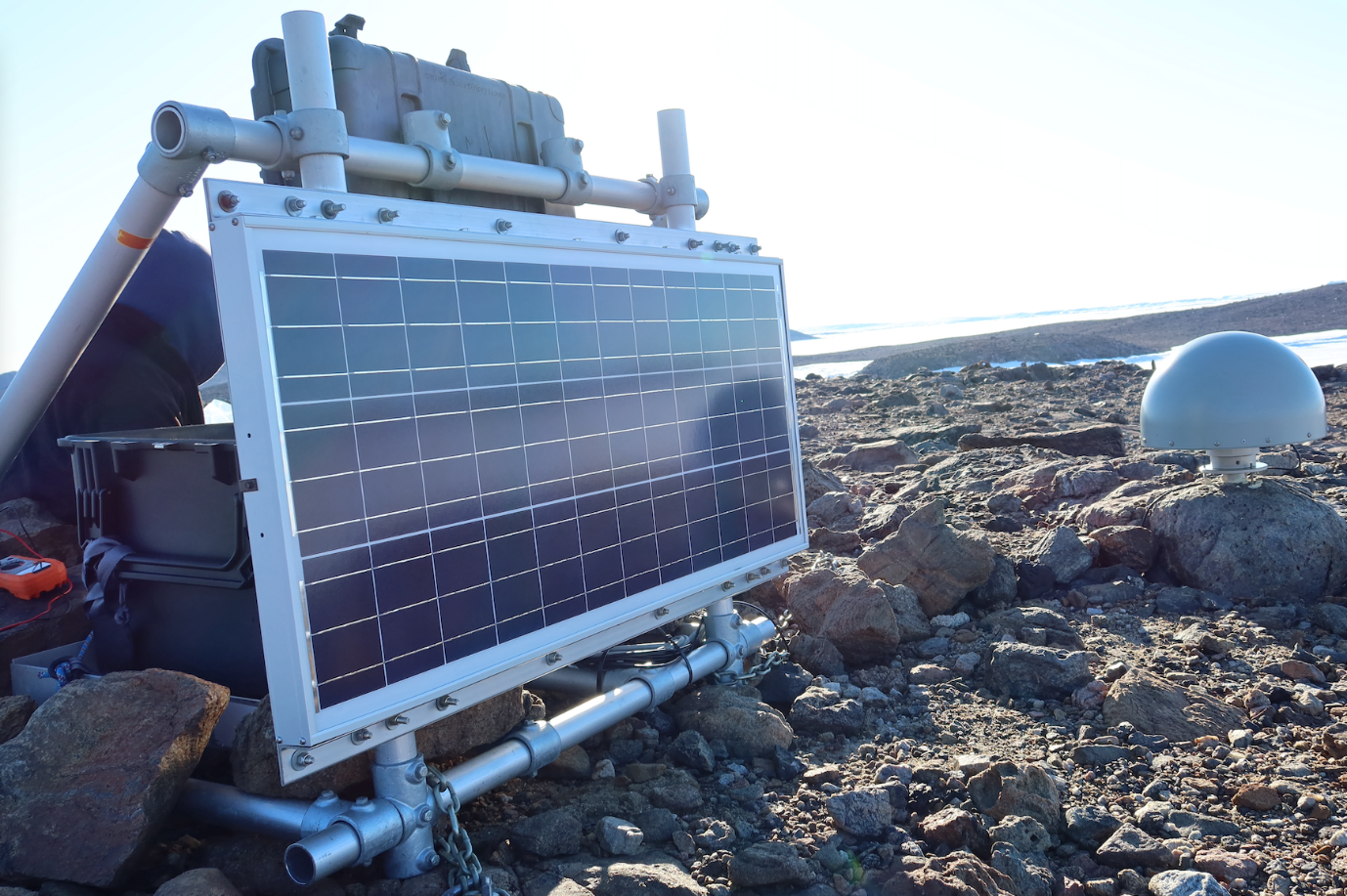
Figure 1. Ongoing GNSS sites on rock allow the measurement of the small vertical motions due to ice unloading and loading (glacial isostatic adjustment) to be measured. Together with knowledge of deep Earth properties such as viscosity, this enables ice mass loss to be tracked. Photo: GNSS site and antenna at Bunger Hills, East Antarctica. Credit: Anya Reading.
2. This research overview, again led by an Early Career Researcher, explains the crustal component of Geothermal heat, and compares different ways of inferring this component from Antarctic and global datasets. Variations in geothermal heat flow can be important considerations in predicting ice sheet response to changed atmospheric and ocean forcing, especially in understanding the probability of melt in areas where the ice sheet is moving slowly over the ground beneath.
Stål, Tobias, Jacqueline A. Halpin, John W. Goodge, and Anya M. Reading. 2024. “Geology Matters for Antarctic Geothermal Heat.” Geophysical Research Letters 51 (13): e2024GL110098. https://doi.org/10.1029/2024gl110098. [pdf]
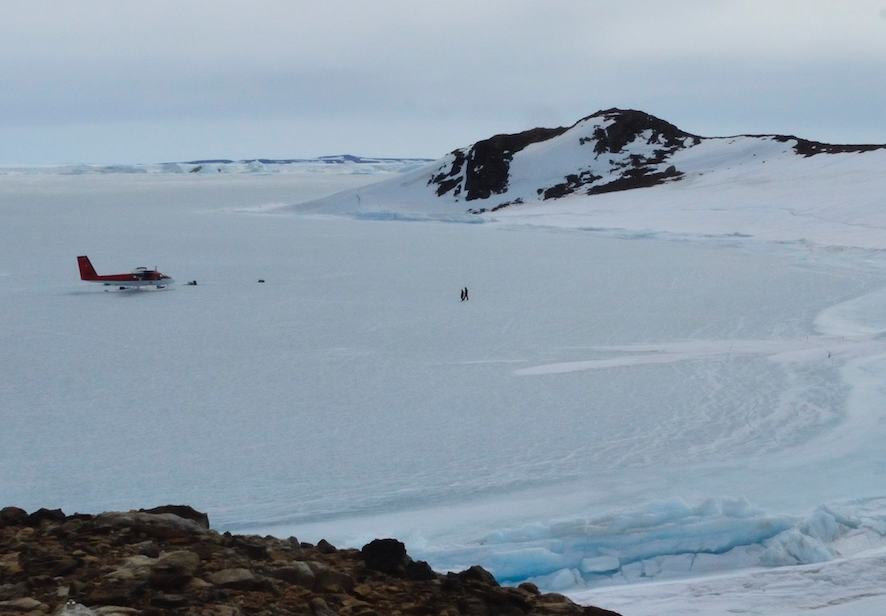
Figure 2. Rock sampling across the vast areas of East Antarctica is helped by remote camps with Twin Otter aircraft access, such as Edgeworth David Camp, Bunger Hills. Computational methods are needed to infer the crustal contribution to geothermal heat, informed by the physical sample information that is now available in shared datasets. Photo: Twin Otter aircraft at Bunger Hills. Credit: Anya Reading.
3. This research presents a new determination of the seismic structure of Antarctic part of Antarctica. This area features sedimentary basins that are especially important as they hold a large volume of the Antarctic ice sheet below present-day sea level. These important features of the upper crust can be better understood using the analysis of ambient seismic energy because this is relatively high-frequency, and therefore allows improved resolution of details in Earth structure. Seismic data also allows characterisation of crust and upper mantle structure, further new knowledge relating to the enigmatic continent hidden beneath the great ice sheets.
Hansen, S. E., and Erica L. Emry. 2025. “East Antarctic Tectonic Basin Structure and Its Implications for Ice-Sheet Modeling and Sea-Level Projections.” Communications Earth & Environment 6 (1): 138. https://doi.org/10.1038/s43247-025-02140-4. [pdf]
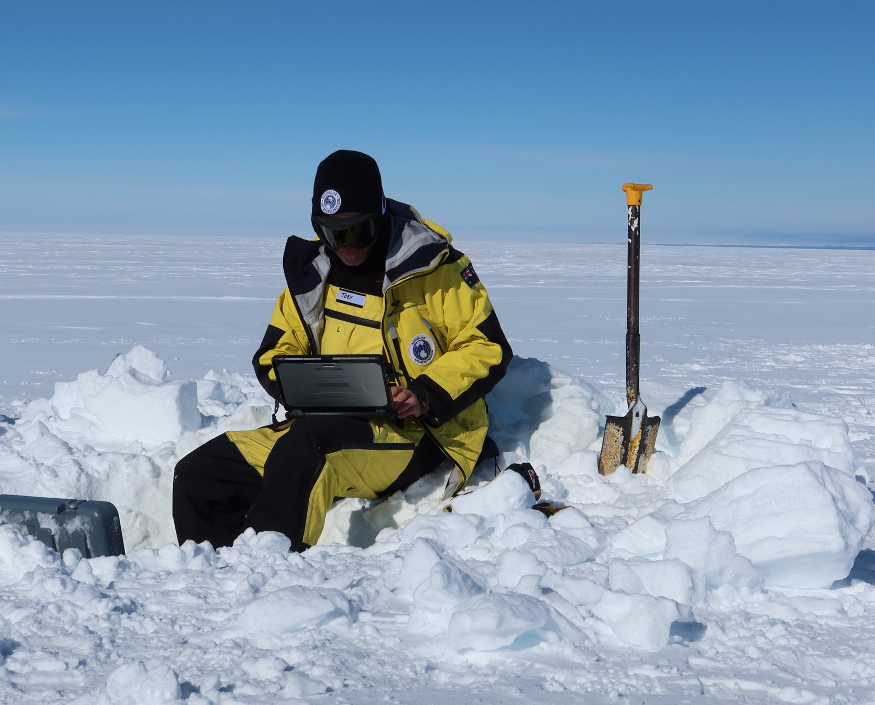
Figure 3. Seismic stations in the interior of the continent of Antarctica are extremely sparse, but can be enhanced by temporary deployments. It has generally been necessary to download data by revisiting the site, although that will change into the future. Photo: Tobias Stål at work at a follow-on temporary seismic deployment with the Australian Antarctic Program. Credit: Anya Reading.